Documentation Guide
See also
- (Internal) Draft Table of Contents Google Doc
- (Internal) the communication guide for information about our writing style (early draft in Google Docs)
- Design style guide for information about our visual identity (already on this site)
- technical guide to our docusaurus sites
High Level Patterns
Page naming and organization
- Title of page must convey what the content of the page is without being overly long
- if needed, use a subtitle to clarify who the audience
- Try to separate pages by content type (inspired by the diataxis approach to documentation)
- overview/marketing - high level 'teaser' page that illustrate at a glance what this is, why you'd want it.
- reference material
- how-to guides
- tutorials. We don't have many of these... yet
- explanation - deeper explanation reasons behind things
- How-tos should use active voice.
- How to create a riverscapes project ✅
- not Creating a riverscapes project ❌
- not Riverscapes projects ❌
- Every page title within a section should ideally be unique to avoid confusion in search results or browser tabs.
- Page titles can repeat information from their parent, but paths should not. For example a page may be titled "Data Exchange API Reference", while its url is
data-exchange/api/reference. The title is not "Reference" and not the url is notdata-exchange/api/data-exchange-api-reference.
Paths
- lower-case and kebab-case, ie data-exchange
- Favour flatter hierarchies over highly nested paths - 4 levels should be the maximum
- nav path can introduce organization that is not part of the URL. In example below, the page who-can-apply is nested under Introduction but "Introduction" is not part of the URL path
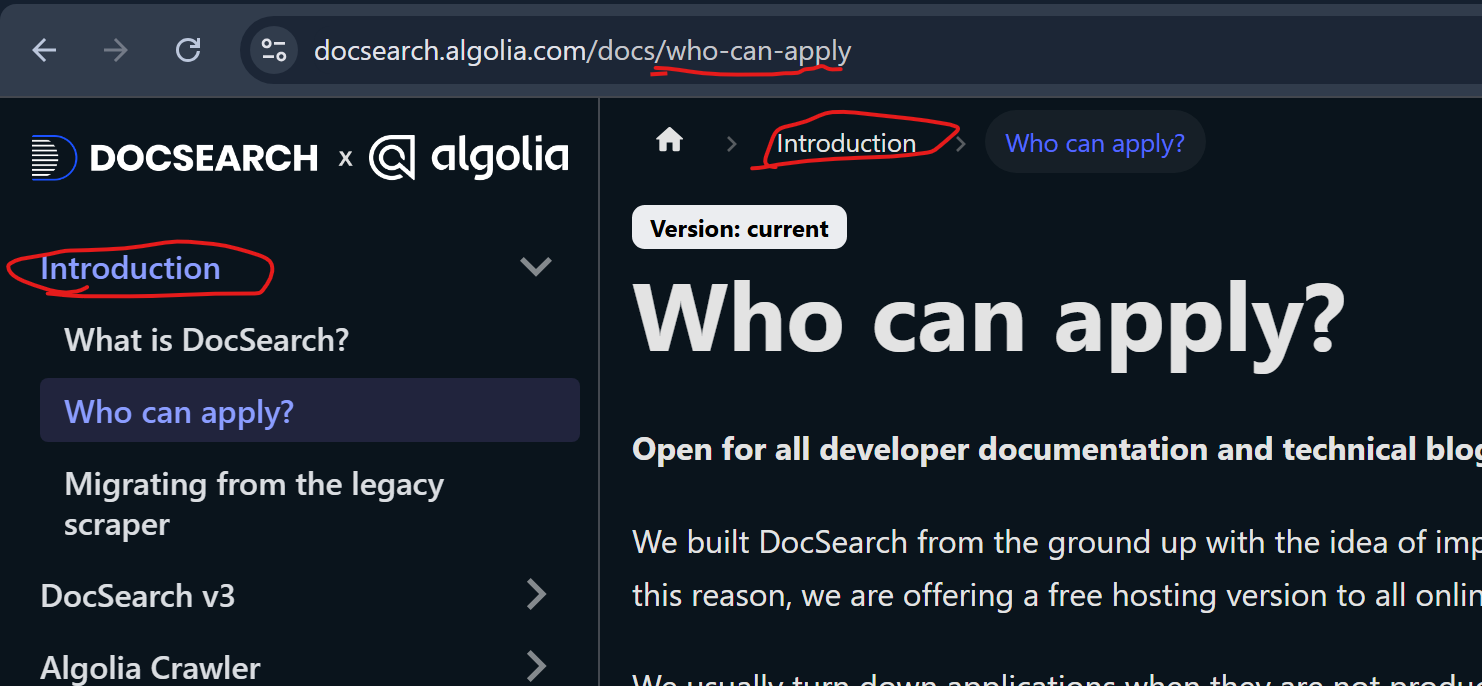
- thus all our major 'products' are top level paths, e.g. data-exchange, viewer, riverscapes-projects
Images
Images should be stored in folder static\img\. If specific to a certain page, put it in a subfolder corresponding to the section.
Outside Examples
Since we are using Docusaurus, looking at other sites that also use this tool is especially useful.